Wednesday, September 7, 2011

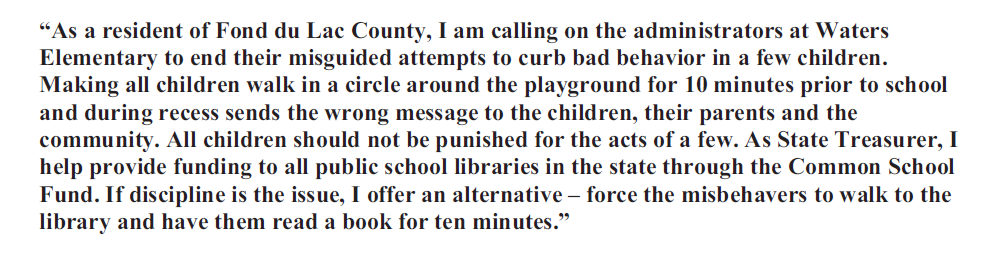
Wisconsin State Treasurer Suggests 'Misbehavers' Be Sent to School Library to Read for 10 Minutes

But on the other hand, he puts in a plug for the Common School Fund without mentioning an alternative use.


Walking at Waters has parents hopping mad. (Fond du Lac Reporter, 9/6/2011)\

Excerpt:   Those passing by the school in the morning last Thursday and Friday may have caught a glimpse of students and teachers following painted blue arrows as they marched around in a circle on the blacktop. According to a new walking curriculum, students are required to walk 10 minutes before school and again during the first 10 minutes of their only recess.

After receiving several complaints, Principal Catherine Daniels sent a robo-message out to parents stating that in the past there have been occurrences of injuries and discipline problems on the playground.

“In an effort to be healthy and safe at Waters School one strategy that we have implemented is the organized walks,” she said.

The walking initiative is exclusive to Waters School, said Gloria Schmidt, community relations coordinator for the Fond du Lac School District
.

Not that it matters since teachers get bogged down focusing on wars and Presidents

Report: Textbooks Ignore Union Contributions. (AFL-CIO Now Blog, 9/6/2011)

Excerpt:   AFT President Randi Weingarten said the report “explains why so few Americans know much about labor’s history and contributions.”

It paints a devastating picture of distortion and omission. Too often, labor’s role in U.S. history is misrepresented, downplayed, or ignored. The result is that most American students have little sense of how the labor movement changed the lives of Americans for the better. A vital piece of U.S. history is disappearing before our eyes
.  [Strikeouts added for effect.]

Here's the American History syllabus as it was once taught in Warren, Pennsylvania -- first to all 8th graders at Beaty Junior High School and then repeated when we were juniors at Warren Area High School.  Both times we barely made it into the 20th century.  Sadly, I suspect the curriculum hasn't changed all that much since the 1960s.


Labor history ignored?  Try social history, business history, technological developments.   If it didn't involve ballots or bullets, fuhgeddaboudit.

Wonder where we'd find Gompers and Lewis on a Q Factor scale today?

Annie E. Casey Foundation's 2011 Kids Count Data Book, State Profiles of Child Well-Being

Families Feel Sharp Edge of State Budget Cuts. (The New York Times, 9/7/2011)

Excerpt:    Whatever the motive, such policy changes come as the downturn has left a growing number of low-income families in worse financial trouble.

The percentage of children living in poverty rose during the last decade, particularly once the recession hit and unemployment soared.

By 2009, about 2.4 million more children’s families lived below the poverty line than in 2000, an increase of 18 percent, according to a recent analysis of Census Bureau data by the Annie E. Casey Foundation, a child advocacy group. In states like this, where Republicans took control of the capital this year, the new cuts have helped resolve Michigan’s expected budget gap, once estimated at $1.4 billion.


Wisconsin has an overall ranking of 12 on the Kids County composite index.

The Herd Instinct in U.S. Politics


Why did the GOP turn against stimulus? Ask a psychologist, by Ezra Klein.  (Washington Post, 9/6/2011)

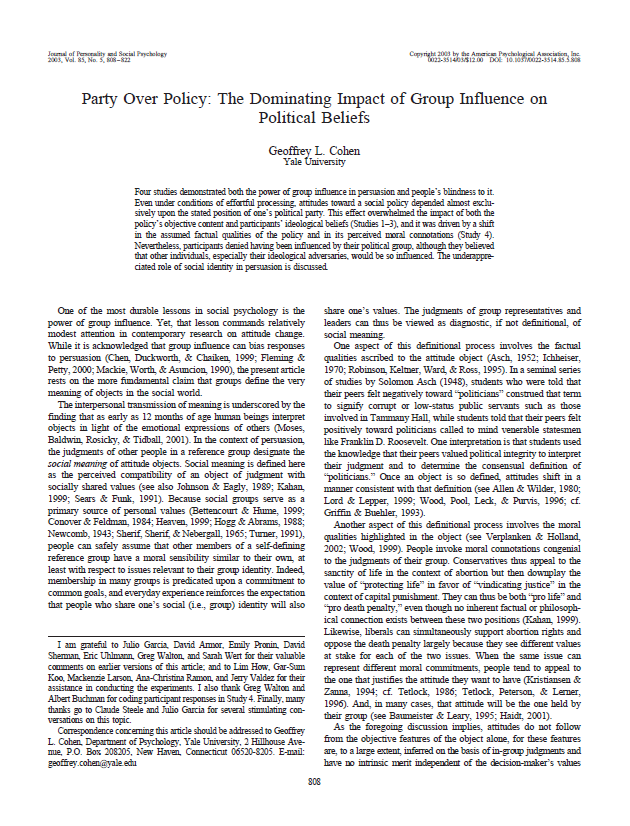
Excerpt:   My favorite study [link here and screenshot of page 1 found below] in this space was by Yale’s Geoffrey Cohen. He had a control group of liberals and conservatives look at a generous welfare reform proposal and a harsh welfare reform proposal. As expected, liberals preferred the generous plan and conservatives favored the more stringent option. Then he had another group of liberals and conservatives look at the same plans, but this time, the plans were associated with parties.

Both liberals and conservatives followed their parties, even when their parties disagreed with their preferences
.

[snip]

The bottom line is this: Until quite recently, both parties supported the idea that you combat bad economies with stimulus spending. Now, during an extremely bad economy, the Republican Party has completely abandoned that position. That has left them without plausible solutions — the GOP talks now of things that have very little role in boosting short-term demand, such as deficit reduction and regulatory reform — and has left the Democrats without the votes to pass anything. And that’s left the country deep in the hole.

PLAYroom @ the Cleveland Heights-University Heights Noble Neighborhood Branch


PLAYroom at Cleveland Heights' Noble branch library helps kindergarten preparation. (Cleveland Plain Dealer, 9/4/2011)

Excerpt: It’s never too early to develop reading skills.

That’s the thinking behind the new PLAYroom at the Cleveland Heights-University Heights Public Library’s Noble Neighborhood Branch. Geared toward preparing young children for kindergarten, the facility hosted a community open house on Aug. 27.

Opened in May in conjunction with the branch’s $1 million renovation, the PLAYroom (Preschool Literacy and You) encourages five activities identified by the American Library Association as crucial to building early literacy skills; singing, reading, writing, talking and playing. This is achieved through activities such as dramatic play opportunities, touch-screen computer stations, technology specifically designed for children with disabilities, interactive wall panels, word labels on items throughout the room and, of course, a “comfortable couch with a nest of pillows for cozy reading.

Zero Percent Increase for Prairie du Sac Department Budgets


Tight budget for Prairie du Sac. (Sauk Prairie Eagle, 8/31/2011)

Excerpt: Trustee Ray Bolton managed to sum up the early prognosis for the upcoming Prairie du Sac Village Budget with one word - "Ouch."

Due mostly to cuts in various revenue sources from the state in its latest budget, the village board is looking to cut $75,000 from next year's operating budget.

"We're going to have our work cut out for us," said village president Cheryl Sherman.

Village administrator Alan Wildman said it will be the toughest budget session in recent memory, and the administrative committee will be meeting more often than usual to identify potential cuts.

Wildman told the village board during its committee of the whole meeting Aug. 23 that it's facing a loss of $39,500 in state aid and $30,000 less in highway and recycling money from the state.

Furthermore, state law prevents the village from raising taxes to pay for its general operating costs. However, Wildman said the village could raise the levy 0.08 percent to reflect its $2.7 million in new construction this year.

The village has requested that its various departments - such as the Sauk Prairie Police Department and the Prairie du Sac Public Library - keep their budget requests at a 0 percent increase
.

Other Wisconsin county and municipal budget news.
City of Ashland looks at projected shortfall of $329,000 in 2012 budget.  (8/26/2011)
Dodgeville city council to hold listening session on 2012 budget.  (8/26/2011)
Shawano budget deficit at $504,800.  (8/25/2011)
City of Ripon facing $110,000 budget deficit for 2012.  (8/25/2011)
Long list of cuts on table for Racine city services.  (8/25/2011)
Dodge County Administrator:  "Governor Walker does not speak for Dodge County".  (8/25/2011)
Longevity bonuses in Portage might become a thing of the past.  (8/24/2011)
Declining property values pose a challenge to Columbus budget development.  (8/24/2011)
Whitewater council looks at 0% tax levy increase.  (8/24/2011)
Janesville residents asked to make tough choices in online budget scorecard.  (8/24/2011)
Village of Darien officials ask for input on 2012 budget.  (8/24/2011)
City of Marshfield has some wiggle room in its 2012 budget development.  (8/24/2011)
Soglin on 2012 Madison budget:  "Every service we rely on is vulnerable".  (8/23/2011)
With a ballooning budget deficit, Marathon County considers a tax increase.  (8/23/2011)
Sheboygan's Strategic Fiscal Planning Committee to determine what city will look like.  (8/19/2011)
Brown County Exec looks at same tax levy, impact on services to be determined.  (8/18/2011)
City of Shawano wrestles with $128,000 deficit.  (8/16/2011)
Possible double whammy for Shawano City-County Library.  (8/15/2011)
Portage County Executive looks to "create a bridge to a new design, a way of functioning on less".. (8/15/2011)
Antigo cuts fire, police positions.  (8/15/2011)
Adding up the budget numbers in the Fox Valley.  (8/14/2011)
Sauk County officials ask for input.  (8/12/2011
Marathon County ranks services to address $500,000 budget shortfall.  (8/12/2011)
City of Beloit faces a challenging budget process.  (8/8/2011)
Fond du Lac city manager sez Governor's tools not enough to offset cuts.  (8/2/2011)
Manitowoc mayor asks department heads for 10% budget cuts.  (8/2/2011)

Big Buzz, Rave Reviews for "The Art of Fielding", Racine Native Chad Harbach's First Book

59 LINKcat holds on 5 copies.

Racine native's first novel generating literary buzz. (Milwaukee Journal-Sentinel, 9/6/2011)

Excerpt:   Racine-born author Chad Harbach spent 10 years laboring on his first novel.

It's about baseball, love, loss and dreams, all set at a fictional Wisconsin college along the shore of Lake Michigan.

While many of his former classmates at Harvard University found success in the workplace, Harbach struggled with the book and struggled to make financial ends meet. He took part-time copy-editing jobs while also cofounding the literary journal n+1.

Harbach's novel, "The Art of Fielding," receives its official release Wednesday, and it is bound to be among the big publishing events of the fall season.

The book, published by Little, Brown and Co., has already brought a financial windfall to Harbach, who received a reported $650,000 advance.

And the novel just received what may be the most important seal of approval in the bookselling world: a rave review in The New York Times from critic Michiko Kakutani
. ("Twist of Fate Derails Fate of Athlete", 9/5/2011)

Two Rivers Council Prohibits Concealed Carry in Public Buildings


Two Rivers rejects concealed carry in city buildings. (Herald-Times-Reporter, 9/6/2011)

Excerpt: The Two Rivers City Council on Tuesday unanimously approved an ordinance prohibiting concealed carry of firearms by citizens in any public buildings or city-owned vehicles.

The ordinance does not apply to peace officers, armed forces or military personnel armed in the line of duty or any person authorized by the police chief of any city, village or town, or the sheriff of any county to possess a firearm in any building.

"This ordinance is … pretty plain vanilla and pretty similar to what a lot of cities across the state are doing," City Manager Greg Buckley said. "It's not meant to be any kind of political statement (about concealed carry)."

Under Wisconsin's concealed-carry legislation, which goes into effect in November, people who obtain a permit and go through training will be allowed to carry concealed weapons in most public buildings unless a sign is posted saying they are not permitted
.

Related posts.
Milwaukee area communities move to ban guns from public buildings. (8/21/2011)
Linus Van Pelt, now all grown up, goes to the dark side.  (8/2/2011
No concealed carry in Columbus public buildings.  (7/25/2011)
A lesson in Wisconsin administrative rule-making. (7/23/2011)
Sheboygan County District Attorney Joe DeCecco calls out gun lobby paranoia. (7/13/2011)
City of Middleton Council votes to approve ordinance to prohibit entry or presence in public buildings while carrying firearms. (7/6/2011)
Milwaukee Public Library trustees ban firearms from all buildings. (6/29/2011)
Milton Mayor and gun-rights advocate Tom Chesmore: Only police should carry guns into city buildings. (6/27/2011)
Dane County and City of Madison propose restrictions on concealed carry. (6/18/2011)
Wisconsin Senate Bill 93: Concealed Carry. (6/10/2011)
Milwaukee Police Chief to Gov. Walker on concealed carry: Exhibit statesmanship and provide adult supervision. (6/4/2011)

Tuesday, September 6, 2011

A Growing Clive Iowa Needs a Library with More Space


Excerpt: The Clive Public Library has long lists of people — mostly children — waiting to participate in library programs that range from baby lap time to “Tales with Tails.”

During the 2011-12 fiscal year, the library turned down 602 people waiting to get into library programs.

“We’ve had waiting lists for a long time, even though we’ve doubled the number of programs that we offer over the last seven years,” said Vicki Hibbert, director of the library.

The problem boils down to a lack of space, Hibbert said. A bond referendum to build a new library building failed in July of 2008. The vote was the same day that gas prices hit $4 per gallon in the Des Moines metro area, Hibbert recalled.

Clive city leaders said the library must expand or change in some major way within the next five years to meet the needs of a growing population
.

Donate to Vermont Public Libraries


Hurricane Irene's Floodwaters Closee New Jersey Library


Hurricane Irene floodwaters damage Penns Grove-Carneys Point Library. (Today's Sunbeam, 9/6/2011)

ExcerptThe Penns Grove-Carneys Point Library will be closed for an undetermined amount of time due to flood and storm damage caused by Hurricane Irene.

“We’re in a flood-prone area and we have some damage,” said Linda Huff, president of the library board of directors on Tuesday. “We hope to re-open as soon as possible, but right now we’re closed for flood cleanup.”

The library, located on South Broad Street, had its rugs and floors soaked. Wooden bookcases are sucking up water, doors have swelled and won’t open, and there has been some damage to drywall, said Huff.

On the positive side, no books were lost, she added
.

Lev Grossman Presents a Short History of the Reading Device

A most fascinating and informative read.


From Scroll to Screen:  Centuries before e-books changed the way people read, the codex replaced the scroll.  (The New York Times Book Review, 9/4/2011)

Excerpt: The last time a change of this magnitude occurred was circa 1450, when Johannes Gutenberg invented movable type. But if you go back further there’s a more helpful precedent for what’s going on. Starting in the first century A.D., Western readers discarded the scroll in favor of the codex — the bound book as we know it today.

[snip]

God knows, there was great literature before there was the codex, and should it pass away, there will be great literature after it. But if we stop reading on paper, we should keep in mind what we’re sacrificing: that nonlinear experience, which is unique to the codex. You don’t get it from any other medium — not movies, or TV, or music or video games. The codex won out over the scroll because it did what good technologies are supposed to do: It gave readers a power they never had before, power over the flow of their own reading experience. And until I hear God personally say to me, “Boot up and read,” I won’t be giving it up.

Legislative Reference Bureau Legislative Brief: Local Redistricting Readjustment


Pew Internet & American Life Project Report: Geosocial Services and Smartphones


28% of American adults use mobile and social location-based services. (Pew Internet & American Life Project report, 9/6/2011)

Excerpt: Fully 83% of all American adults ages 18 and older own a cell phone, a number that has remained relatively steady since mid-2008. Of these cell phone owners, 42% own a smartphone, which translates to 35% of all adults.3 Almost six in ten (58%) of these smartphone owners use a geosocial or a location-based information service of some kind.

Another Author of Adult Fiction Tries His Hand at a Book for Young Adults

Don't Try This Experiment Unsupervised


Can't resist that marshmallow? Self-control doesn't get easier with age. (Ars Technica, 9/6/2011)

Excerpt: Forty years ago, Walter Mischel conducted a simple yet elegant experiment in which he asked four year old children to resist eating a marshmallow while he was out of the room. He promised that if they hadn't eaten it by the time he returned, they could have two marshmallows. Mischel observed that, while some children were able to resist the tantalizing treat, many others could not. But he didn't stop there—20 years later, he checked again and found that the children who were able to delay their gratification had grown into adults who exhibited greater levels of self control.

It has now been four decades since this experiment, and Mischel and his colleagues are still following some of the participants of the original marshmallow test. In this week’s PNAS, the team reports that the children's differences in self control are still evident after forty years, and there is new information about why some people's brains may be worse at controlling impulses.

In the first part of the new experiment, Mischel and his team were looking for more subtle behavioral differences between "high-delayers" (those who didn’t eat the marshmallow early) and "low-delayers" (those who could not resist the temptation). They wanted to test whether positive social cues would be more difficult for low-delayers to resist. Fifty-nine participants from the original marshmallow experiment were invited to take part in this new experiment; these people had either performed above average on the marshmallow task or had performed particularly poorly
.

Click here to take survey

Center on Wisconsin Strategy Report: The State of Working Wisconsin


Selected highlights.

Unemployment:  Stubbornly High
The official unemployment statistic, updated each month, makes the suffering in this labor market clear. Some 239,000 Wisconsinites were actively seeking work but unable to find a job in July 2011. But the reach of unemployment is broader than a single month suggests. Given the flow into and out of unemployment, over the course of a year, unemployment touches many more workers than it does in a single month.

Long-Term Unemployment at Unprecedented Highs
Fully 40 percent of Wisconsin’s unemployed workers have been unemployed for more than six months. For comparison, just 11 percent of the unemployed in 2000 had been seeking work for more than six months. Not only are Wisconsin workers much more likely to be unemployed today, they are also much more likely to stay unemployed for long periods of time.


Unemployment Understates Labor Market Misery.
At some point in their job search, unemployed workers begin to give up. Instead of reporting that they are “actively seeking work” they stop looking for a job. When this happens, the workers are no longer “unemployed” and no longer count in that central statistic of economic suffering.

Weak Labor Market Hits Hardest Those with the Least.
Younger workers and less educated workers also face higher levels of unemployment and involuntary part-time work. And while unemployment for the state is under 8 percent, it is at or over 10 percent for men (10 percent), for workers ages 16-24 (16 percent), for workers with less than a high school education (19 percent), for workers with high school degrees but no additional education (11 percent), for African Americans (25 percent), and for Hispanics (10 percent)..

The Geography of Unemployment.
Unemployment is distributed unevenly across Wisconsin, as the map of July 2011 unemployment by county makes clear. (See Figure 5.) The table shows high unemployment counties which include urban areas that have suffered major manufacturing losses (Rock, Kenosha, and Milwaukee counties, for example) but also more rural counties in the state that are reeling from job losses.


Conclusion
The unemployed are not the problem. Lack of attention and commitment to building a strong economic recovery is the problem. And until we move more aggressively on that, the unemployed will continue to suffer.

Speaking Up for the Chase Branch of the Detroit Public Library

Chase Branch

Neighborhood plans effort to save its library. Detroit's Chase branch is among six slated to be closed. (Detroit News, 9/6/2011)

Excerpt:    It was a perfect summer night for being outdoors. Instead, the Detroit Public Library's Chase branch was packed.

Computer terminals were all in use Thursday, including one by a young mother searching for jobs online with a baby on her lap. A college student was studying near a group of teenagers playing cards.

And 40 members of the Fenmore Street Block Club were packed in a meeting room with a police officer discussing safety issues.

But the neighborhood gathering place could soon close under a cost-cutting plan, which has mobilized users into action, planning protests and letter-writing campaigns to try to save their branch.

"If you let them take this away, what is the next thing that will happen?" asked G. Peggy Noble, the block club president. "We are going to have to get together if you care about your neighborhood."

The branch, on Seven Mile near the Southfield Freeway, is one of six slated to close under a proposal by Detroit Public Library administrators, who say layoffs in March have stretched the staff too thin.

But the plan comes three months after officials abandoned plans that would have closed as many as 18 branches.

The six branches were targeted based on several factors, including building condition, usage and neighborhood population.

The library's Board of Commissioners is expected to vote on the plan by the end of September
.

Related articles:
6 branches being considered for closure. (8/24/2011)
Library commissioners reorder 10% pay cuts for top 3 library administrators.  (7/8/2011)
Ernie Hallwall memorabilia.  (6/9/2011)
Library commission aism high.  (5/25/2011)
Library u-turn:  no branch closures, no layoffs.  (5/21/2011)
The next thing you know..... (5/20/2011)
My boss has a 2010 Buick LaCrosse....   (5/19/2011)
Detroit Public Library revised its math.  (5/17/2011)
Detroit Public Library does the math....incorrectly.  (5/14/2011)
Residents speak up against branch closings.  (5/8/2011)
The library takes a page from the 1979 Pittsburgh Pirates.  (5/7/2011)
The news just keeps getting worse. (5/6/2011)
The Detroit Public Library needs some good news (and this isn't it).  (5/5/2011)
Rainy day fund keeps fewer branches from closing.  (4/29/2011)
Proposal to close 18 of 23 Detroit branches sparks anger. (4/22/2011)
Few expenses spared in South Wing remodeling of library.  (4/22/2011)
Downward spiral.  (4/16/2011)
Library reduces staff by 20%. (3/4/2011)
Budget woes. (2/5/2011)

Former Director of Global Knowledge Management at 3M Brings Her Skills to Hudson Area Library Board


Newest library board member is highly qualified.   (Hudson Star-Observer, 9/1/2011)

Excerpt: The newest member of the Hudson Area Library Board certainly has the credentials for the position.

Barbara J. Peterson was the director of library and information services for 3M Co. for much of her career.

At one time, she was responsible for the company’s nine technical libraries, a business library, an engineering library, a patent library, a technical-knowledge database and 80 employees.

After almost 30 years with 3M Co., she completed her career with a four-year stint at Ecolab.

“I had a wonderful job title at Ecolab — director of global knowledge management,” Peterson reported with a laugh
.

Wedding Dress and Accessory Display Planned @ the River Falls Public Library


River Falls library seeks area wedding dresses with a story. (Hudson Star-Observer, 9/2/2011)

Excerpt: It’s a given that every bride is beautiful, but over the decades wedding costumes and customs have varied.

Jera Terreng and Rita Kozak suspect that many area residents may have, stored in a back closet somewhere, dresses or suits that exemplify an era or come with a unique back story. Please bring them out, they ask.

“We’re looking for dresses that have a story,” said Kozak, who will be curating a wedding dress and accessory display at the River Falls Public Library’s lower level gallery.

“In the gallery we try to have a nice mix of art and history,” said Terreng, the library’s events and gallery coordinator. She said many of the exhibits are “hard-core history,” and added, “It’s really fun to show people a cut of local history and culture.”

She said she wants to balance the library’s exhibit year with a bit of regional history. And, Terreng said, the wedding exhibit “seemed like a lovely thing to do around the holidays.”

The show will open Dec. 17 and run through Jan. 26, 2012, but Kozak wants to know soon what’s stored in area closets
.

Some Wisconsin Counties and Municipalities Approve "Temporary Pay Equity Adjustments"


Some nonunion government workers get pay increases to offset pension contributions. (Milwaukee Journal-Sentinel,

Excerpt: With new pension contributions in place at 5.8% of pay, a number of municipalities and counties are giving nonunion employees temporary pay increases to cover most or all of the costs through the end of the year.

They say it's to level the playing field for nonunion employees working side-by-side with union workers who for now avoid the new pension payment requirement because they remain under previously adopted contracts.

Dane County, Madison, La Crosse, La Crosse County, Fox Point, Summit and Hartland are among the municipalities that have approved what some refer to as a "temporary pay equity adjustment."

"It is to make things as fair as we can make them for city employees so that those employees that may not be represented by a union are not punished for that fact," La Crosse Mayor Mathias Harter said of the 5% increase that was approved in August and runs through the end of the year, when union contracts expire and represented workers start making the pension payment
s.

Executive Mansion Fundraising Event for 1800 of Scott and Tonette Walker's Closest Friends


Walker's fundraiser to restore mansion raises some eyebrows. (Milwaukee Journal-Sentinel, 9/5/2011)

Excerpt: On Sept. 22, the governor and first lady will hold a private reception and croquet tournament at the governor's mansion from 5 to 7 p.m. to raise money to help rehab the Maple Bluff facility.

Attendees can donate anywhere from $50 to $1,000 to the mansion's nonprofit foundation. Those who drop a grand get a "private reception, private tour, recognition on the invitation, signage and acknowledgment at the event, and admission and (croquet) tournament entry for two."

Fundraising invitations went out recently to scores of Madison lobbyists, female lawmakers, neighbors of the mansion, GOP campaign contributors, leading business officials and friends of the first couple. Some 1,800 people received an invite
.

Early history of the Wisconsin executive residence. Wisconsin Magazine of History, December 1937.

Monday, September 5, 2011

Houston Oral History Project


Houston's Indian immigrants telling their stories. (Houston Chronicle, 9/4/2011)

Excerpt:   When then-Mayor Bill White announced an oral history project capturing the stories of prominent Houstonians a few years ago, Krishna Vavilala noticed one group missing: Indian immigrants who have shaped the city's demographic landscape in subtle but influential ways.

So Vavilala, also chair of the Foundation for India Studies at the University of Houston, decided to start one himself.

"If someone else won't write our history, we will write it," said Vavilala, a native of India who came to Houston in 1981 after entering the U.S. through New York in 1974.

In coordination with the Houston Public Library, the foundation started its first interviews this summer to capture the stories of early Indian immigrants' lives prior to moving to America, as well as their struggles to adapt and their contributions to the city, which have gone largely unrecorded
.

Point/Counterpoint: Novelists Predict Future


One of the book mentioned in the New York Times piece.
79 holds in 12 (print) copies in LINKcat.

The 21st Century Camping Experience: Not Getting Away From It All

Jellystone bucks the trend?
(No mention of wi-fi on homepage)

Now even the wilderness is wired. (San Jose Mercury News, 9/5/2011)

Excerpt:   Thanks to the mobile revolution, getting away from it all isn't what is used to be.

Campground owners have not just made peace with this trend, but are now installing Wi-Fi services or expanding existing ones to meet the demands of campers who want to remain connected. They are also investing in additional electrical outlets and lobbying for upgrades to nearby cell towers to accommodate those data-hogging smartphones and other connected devices we can't seem to put down.

"Wi-Fi has gone from being a luxury item to being the No. 1 demanded amenity at campgrounds," said Jim Ames, owner and CEO of Airwave Adventurers, a Napa-based business that installs wireless systems in campgrounds. "If you don't have Wi-Fi, most likely you're going to lose your business
."

Size Matters in the Production of Cleaner Milk (but no mention of who funded the study)


Wisconsin study: Big dairies produce cleaner milk. (Wisconsin State Journal, 9/5/2011)

Excerpt:   With buying from small, local, family-run farms becoming more popular, the results of a new study from Wisconsin could be surprising: It found that milk from big dairies is cleaner than that from small ones.

Lead researcher Steve Ingham said he did the study because he wanted to see whether there was a link between milk quality and the size of a dairy farm. He said the results cast doubt on the perception that big dairies can't matcher smaller ones in terms of quality.

"Certainly, the small-is-better blanket statement doesn't appear to be true," said Ingham, who started the study when he was a food science professor at the University of Wisconsin-Madison and is now a food safety division administrator at the Wisconsin Department of Agriculture, Trade and Consumer Protection
.

The study is published in the August 2011 issue of the Journal of Dairy Science.

The reason I raise the point......


Excerpt: These were the key findings from a life-cycle assessment study presented by Dr. Jude Capper of Washington State University on July 13 at the Joint Association Meetings of five North American scientific societies for animal agriculture, including the American Dairy Science Association and the American Society of Animal Science.

The Journal of Dairy Science is the official publication of the American Dairy Science Association.

And in this case.....

Major funding for this research was provided by National All-Jersey Inc., representing 1,000 producer members to promote the increased production and sale of Jersey milk and milk products.

American Rights at Work: Unions Making a Difference

Wisconsin Technical Colleges Celebrate Their 100th Anniversary


After 100 years, Fox Valley Technical College still teaching essential skills. (Oshkosh Northwestern, 9/3/2011)

Excerpt: The school that would eventually become FVTC was created after legislation was passed in 1911 required all communities with more than 5,000 residents to establish continuation schools. These schools were started for boys and girls between the ages of 14 and 16 that had quit school in order to go work, but needed to learn the skills needed to succeed in the work force. The continuation school that opened in downtown Oshkosh in 1911 was the first to open its doors in the region.

While it's no longer known as a continuation school, FVTC continues to do the same thing it started out doing 100 years ago: Giving students the skills employers are looking as they enter the workforce
.

Jacquelyn Mitchard Looks to Bounce Back from "Financial Holocaust"


Mitchard writing her own comeback. (Wisconsin State Journal, 9/4/2011)

Excerpt: As Mitchard enters the Muskego Public Library for her reading, there’s a nice buzz in the air.

Fans began showing up an hour early to get a good seat. Staff members are scrambling for more chairs.

Erin Shaughnessy, 39, of New Berlin, a high school librarian, says she’s loved Mitchard for years and couldn’t wait to see her. “She’s lived a life that’s very real and very honest,” Shaughnessy said. “Nothing seems put on.”

By the time Mitchard goes on, there are 107 people in the audience. The library has hosted more than 200 guest authors in the past 10 years, and no one has drawn this big a crowd, said the library’s director, Jane Genzel.

Mitchard opens by reading some of the negative reviews her writing has received in the past, laughing along with the audience. (“Why won’t she stop?” asks one reviewer.)

As Mitchard reads a passage from “Second Nature,” the audience sits rapt.

“I’m still feeling the immense emotion you wrote into the book,” one audience member, Patricia Hintz, 56, of Muskego, an elementary school teacher, later says during the Q&A.

As Mitchard autographs books afterward, several people share personal stories of overcoming financial setbacks.

On the drive back to Madison, Mitchard calls the event “restorative.”

“What a shot in the arm to know there are people out there who may read this book.”

She can do this, she says. She can bounce back
.

Sunday, September 4, 2011

Buffalo News Launches "Bucks for Books" Program


Buffalo News, 9/4/2011.

Excerpt: The Buffalo News is starting "Bucks for Books" today to purchase children's and adult books for the Buffalo & Erie County Public Library system.

The goal is to raise $250,000 to help offset an expected loss of $900,000 in funding for purchase of materials in 2012. The donations will be used to purchase books at all 37 branch libraries
.

Related articles:
More visits but fewer hours, staff and acquisitions.  (9/4/2011)
Erie County Exec's 2012 library allocation will "necessitate major changes". (6/7/2011)
County Exec builds a surplus by pulling the rug from under the library. (4/27/2011)
Funding picture gets progressively worse.  (2/26/2011)
Unhappy times continue.  (1/21/2011)
Library officials ask for final decision on budget. (12/22/2010)
Additional funding for library but not for arts groups.  (12/12/2010)
Legislators restore County Executive's $4,000,000 cut to library - for now.  (12/2/2010)
"No more worthwhile program of service".  (11/14/2010)
A bibliopocalypse @ the library.  (11/6/2010)
WBEN online poll offers 3 general options for public library future. (10/31/2010)
Reimagining the library.  (10/27/2010)
Budget cuts = reduced hours.  (10/21/2010)
Deep cuts (again) in the works.  (9/17/2010)
Editorial puts in 'a word about libraries'.  (8/30/2010)
Library could lose 25% of funding.  (8/19/2009)

More Visits But Fewer Hours, Staff, and Acquisitions @ the Buffalo & Erie County Public Library


It's a brave new world at the library. (Buffalo News, 9/4/2011)

The Buffalo & Erie County Public Library system had 3.9 million patron visits in 2010, a 10-year high that continued a five-year trend.

At the same time, it has had its budget reduced by the state and, more dramatically, the county in recent years, resulting in 6.7 fewer weekly hours per branch, 45 fewer full-time staff and fewer acquisitions in 2011. Full-time staff, which stood at 398 in 1995, is now 179.

"What concerns us is what is lost along the way," said Tim Galvin, president of the librarians union. "The quality of service we provide has been diminished, including the level of human interaction people are used to."

County Executive Chris Collins has offered to restore $2 million from a "rainy day fund" for 2012, and assume the Central Library's $1.3 million utility costs. That, together with an expected fund balance, "reductions and tweaks" in the budget and savings in fringe benefits should keep service levels largely intact, said Kenneth H. Stone, the library system's chief financial officer.

The system still faces a $900,000 shortfall for acquiring new materials in each of the next three years, which will drastically shrink its ability to stay current with materials and to afford replacements.

Related articles:
Erie County Exec's 2012 library allocation will "necessitate major changes". (6/7/2011)
County Exec builds a surplus by pulling the rug from under the library. (4/27/2011)
Funding picture gets progressively worse.  (2/26/2011)
Unhappy times continue.  (1/21/2011)
Library officials ask for final decision on budget. (12/22/2010)
Additional funding for library but not for arts groups.  (12/12/2010)
Legislators restore County Executive's $4,000,000 cut to library - for now.  (12/2/2010)
"No more worthwhile program of service".  (11/14/2010)
A bibliopocalypse @ the library.  (11/6/2010)
WBEN online poll offers 3 general options for public library future. (10/31/2010)
Reimagining the library.  (10/27/2010)
Budget cuts = reduced hours.  (10/21/2010)
Deep cuts (again) in the works.  (9/17/2010)
Editorial puts in 'a word about libraries'.  (8/30/2010)
Library could lose 25% of funding.  (8/19/2009)

The Rotten State of American Politics


Goodbye to All That: Reflections of a GOP Operative Who Left the Cult. (Truthout, 9/3/2011)

Excerpt:   But both parties are not rotten in quite the same way. The Democrats have their share of machine politicians, careerists, corporate bagmen, egomaniacs and kooks. Nothing, however, quite matches the modern GOP.

To those millions of Americans who have finally begun paying attention to politics and watched with exasperation the tragicomedy of the debt ceiling extension, it may have come as a shock that the Republican Party is so full of lunatics
.

The Los Angeles Times Presents a Manhattan Tour for "Old-Fashioned Book People"

New York City's spots for book lovers.   (Los Angeles Times, 9/4/2011)

Excerpt: These are dire days for old-fashioned books. The 48 bookshops that once lined Manhattan's Book Row on 4th Avenue are gone or relocated. By the end of September, the bankrupt Borders chain's last outlet is expected to close. At Amazon.com, ebooks outsell hardbacks. As those marble lions in front of the New York Public Library celebrate their 100th anniversary, Kindles, Nooks, iPads and their ilk multiply like bunnies in bedrooms and airline cabins around the planet.

So, old-fashioned book people, hit literary Manhattan soon and hard. Even if you have only three days, as I did earlier this year, you can squeeze in an eight-stop tour, complete with thinking, drinking, Bibles, tote bags and a certain pair of municipal mascots. Here's how my circuit went
.